
OUR UNFINISHED STORY / JOURNAL ENTRY
Car Talk: A way to get the conversation going...
By Psyching Life · A mother’s perspective · · 4 min read
I talk to people about their feelings for a living. Then I try to find out what happened at school.
Apparently, these are two very different skill sets.
I want to know my kids. What they find funny. What they’re thinking about. What’s happening with their friends. But starting an interesting conversation with a teenager can feel surprisingly difficult, especially when my way in is to ask questions.
Me: “How was your day?”
Teen: “Fine.”
Me: “Anything interesting happen?”
Teen: “Come on, bruh…”
Me: “I’m just asking!”
Teen: “It’s not that deep.”
An illustrative parent-and-teen exchange. You may recognize the general atmosphere.
Okay. Apparently it is not that deep. But could we get slightly deeper than “fine”?
My temptation is to keep going. Ask a more specific question. Try a different topic. Surely there is some combination of words that will get us somewhere. Meanwhile, what feels like interest to me may start to feel like an interview to them.
I’m trying to have a conversation. They may be trying to have a snack.
Want to give it a try? Get the printable cards or open them on your phone ↓
A different way to get things moving
That’s the idea behind our conversation-starter cards: a different place to start. Something a little less predictable than another question about school, and hopefully a little more interesting for both of us.
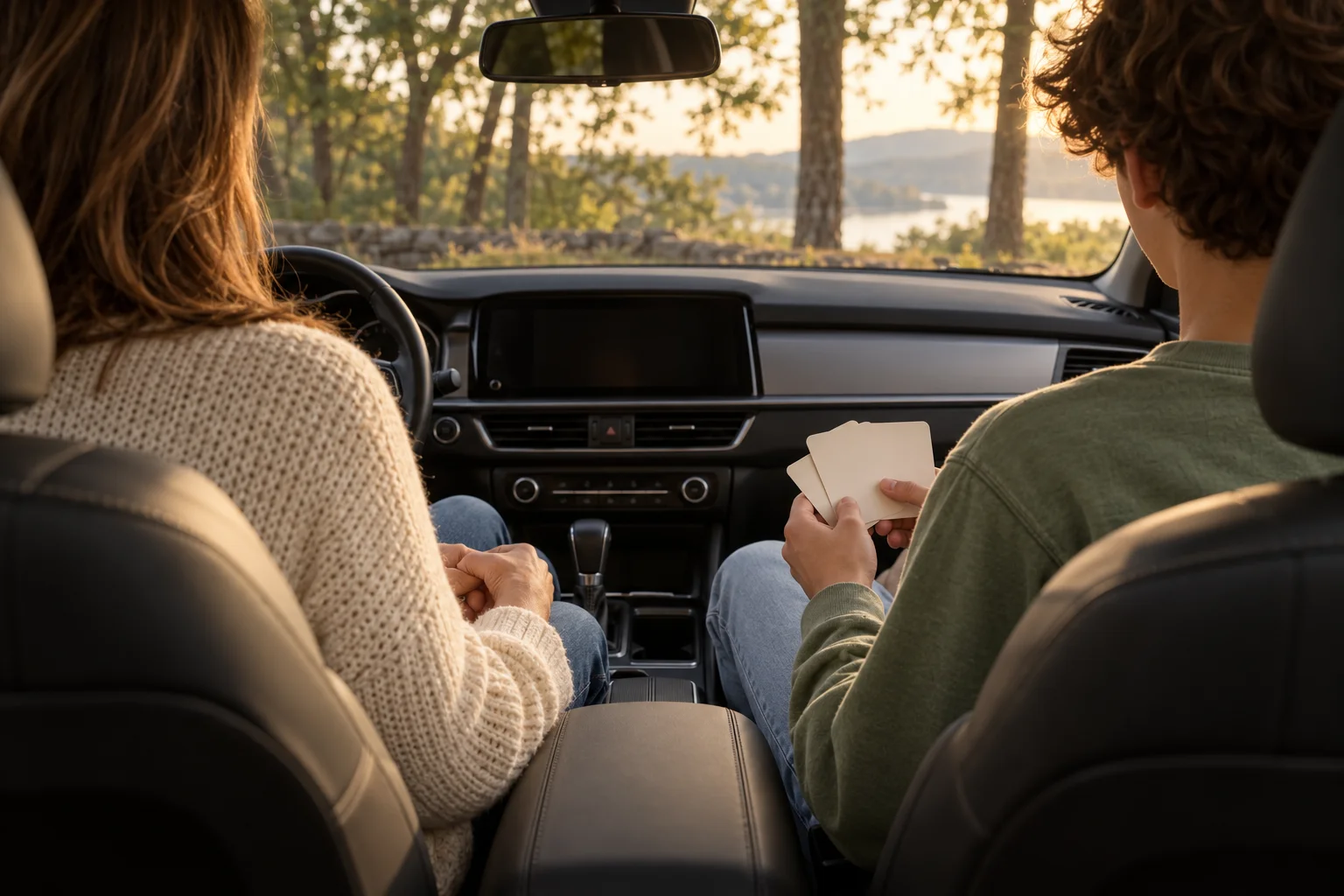
We can try one question at dinner, while hanging out, or in the car when someone else can handle the phone. It doesn’t need to become a serious conversation. A funny answer, an unexpected story, or a little more substance than “nothing” would be a perfectly good start.
Here’s a moment from our “Car Talk” recording script:
Me: “If today had a weather forecast, what would it be?”
Teen: “…Cloudy. Chance of a chem test.”
That gives us something to work with. We don’t have to leap straight into advice about studying, either. We can be curious about the answer and let the conversation go somewhere we didn’t plan.
They get to ask us, too
This part matters. The cards include questions for us to ask our teens and questions for them to ask us. We’re not just asking them to perform openness while we sit there evaluating the answers.
In the script, the teen’s next question is: “What’s something you got in trouble for at my age?”
And suddenly I’m very interested in whether our ten minutes are up.
They get to ask us, too. And anyone can pass.
There are light questions, silly questions, and some that leave room for a more personal conversation. The deeper questions are optional. Passing doesn’t require an explanation, and we get to pass, too.
Keep it a conversation, not an assignment
We can offer a short round: “Want to try a couple of these? You get to ask me, too.” Ten minutes is an option. So is one question.
If an answer turns into a conversation, stay there. There’s no prize for getting through the deck. And if the answer is surprising, I want to notice my urge to correct it, explain it, or turn it into a lesson before I’ve really heard it.
These cards won’t guarantee that a teenager opens up. Sometimes they’re tired. Sometimes the timing is off. Sometimes we’ll still get a “bruh.” We can leave the invitation open and try another time.
The hope is to get something moving: a laugh, a story, a question back. At the very least, maybe a little more substance from our teens. And a chance for them to learn something about us, too.
This is how I’m psyching life: I can get a stranger talking in fifty minutes. My teenager? I need flash cards.
A SMALL WAY FORWARD
What we’re practicing
- Invite rather than insist. Ask whether they want to try one question. Ten minutes is an option, not a requirement.
- Let it go both ways. Make room for their questions, and give an honest answer of your own.
- Honor the pass. No explanation, pressure, or surprise follow-up interrogation.
- Stay with the answer. Listen before offering advice. One good conversation can be enough.
FROM THE STORY INTO REAL LIFE
Get the conversation cards
Choose paper or phone. These conversation resources are free, with no email signup required.
PRINT AND TAKE ALONG
Conversation-starter cards
92 questions, with cards for parents to ask and cards for teens to ask. Eight pages to print and cut. Deeper questions are optional; anyone can pass.
The quick list is two PDF pages, designed for one sheet printed double-sided.
ONE QUESTION AT A TIME
Swipe through the questions
Choose Parent asks, Teen asks, or Take turns. Use Next or Pass, undo a card, and try the optional ten-minute timer. No account or installation is required.
Use while parked, or let a passenger handle the cards. Drivers keep their attention on the road.
A little help for the week ahead.
Get free weekly resources to go with what we’re exploring, including a practical prompt to try at home.
Free weekly resources by email. Confirm your email to get started. Unsubscribe anytime.